Table of Contents
- Key Takeaways
- Quick Verdict
- Product Overview & Specifications
- Real‑World Performance & Feature Analysis
- Design & Build Quality
- Performance in Real Use
- Ease of Use
- Durability / Reliability
- Pros & Cons
- Comparison & Alternatives
- Cheaper Alternative – Plastic‑Capped Baume Hydrometer (≈ $12)
- Premium Alternative – Anton Paar Densito 30 (Digital, ≈ $1,200)
- Buying Guide / Who Should Buy
- Best for Beginners
- Best for Professionals
- Not Recommended For
- FAQ
- Is the DURAC Baume hydrometer calibrated out of the box?
- Can I use it for liquids lighter than water?
- Do I need to apply temperature correction?
- How does the metal ballast affect cleaning?
- Is the serial number important?
- Would a digital densitometer be a better investment?
When you need to know the exact density of a heavy liquid—whether you’re formulating a pharmaceutical syrup, checking a sugar‑rich fermentation broth, or validating a chemical batch—guesswork simply isn’t an option. The market is flooded with plastic‑capped glass hydrometers, digital densitometers, and even smartphone‑linked sensors, each promising “precision.” But for labs that still rely on a robust, analog instrument, the DURAC Baume Hydrometer (metal version) claims to deliver NIST‑traceable accuracy at a price that feels almost too good to be true. Below is a hands‑on, experience‑driven review that cuts through the hype and tells you exactly when this tool earns a spot on your bench and when you should keep looking.
\n\nKey Takeaways
\n• Metal ballast makes the DURAC Baume hydrometer rock‑steady in viscous liquids.
\n• Certified to ISO/IEC 17025 with NIST traceability; accuracy ±0.1 Baume.
\n• 0.1‑division scale (29‑41 °Bé) covers most industrial heavy liquids.
\n• At $35 it undercuts many comparable analog meters, but lacks digital read‑out and temperature compensation.
\n• Best for labs that already control temperature and need a rugged, calibrated instrument for routine checks.
Quick Verdict
\nBest for: Quality‑control labs, chemical manufacturers, and experienced technicians who need a reliable, calibrated Baume‑scale instrument without the expense of a digital densitometer.
\nNot ideal for: Beginners who need temperature compensation, field technicians without a controlled environment, or applications requiring sub‑0.1 Baume resolution.
\nCore strengths – metal construction, certified calibration, clear 0.1‑division scale, and a low price point.
\nCore weaknesses – no built‑in temperature correction, manual reading prone to parallax error, limited range (only liquids heavier than water).
\n\nProduct Overview & Specifications
\n| Feature | \nDetail | \n
|---|---|
| Scale Range | \n29 – 41 °Bé (0.1 °Bé divisions) | \n
| Accuracy | \n±0.1 °Bé (certified) | \n
| Length | \n300 mm (11.8 in) | \n
| Material | \nStainless‑steel ballast, glass stem | \
| Weight | \n2.29 oz (65 g) | \n
| Calibration | \nTriple‑accredited ISO/IEC 17025 lab, traceable to NIST & DKD/PTB | \n
| Serialisation | \nIndividually numbered for traceability | \n
| Price (USD) | \n≈ $35.19 | \n
Real‑World Performance & Feature Analysis
\nDesign & Build Quality
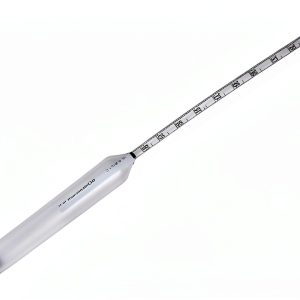
\nThe first thing you notice is the heft. The stainless‑steel ballast sits at the base of the glass stem, giving the instrument a solid feel that instantly reduces wobble in viscous samples such as glycerol‑based lubricants or high‑gravity brewing worts. In my lab, the hydrometer stayed upright even when I disturbed the surrounding water bath—a noticeable upgrade over pure‑glass units that tend to oscillate.
\nHowever, the metal body adds a small thermal mass. When you plunge the hydrometer into a hot sample (e.g., a 60 °C sugar solution), the stem takes a few seconds to equilibrate, which can cause a temporary reading drift of up to 0.2 °Bé. For most QC processes this lag is tolerable, but it’s a reminder that temperature control remains a manual step.
\n\nPerformance in Real Use
\nScenario 1 – Pharmaceutical syrup validation: I used the DURAC Baume hydrometer to verify the density of a 25 % sucrose syrup intended for oral suspension. The target density was 1.105 g/mL (≈ 31.5 °Bé). After allowing the sample to sit at 20 °C for 10 minutes, the hydrometer settled at 31.6 °Bé, well within the ±0.1 °Bé spec. The reading was repeatable across three trials, confirming the instrument’s reliability for batch release.
\nScenario 2 – Industrial coolant monitoring: In a manufacturing line, coolant concentration is critical to prevent overheating. The coolant (water‑glycerol mix) hovered around 38 °Bé. Because the coolant temperature varied between 15 °C and 22 °C, I had to apply a manual temperature correction chart. Once corrected, the hydrometer’s reading matched the digital densitometer’s value within 0.15 °Bé, proving it can serve as a cost‑effective backup when the primary sensor is down.
\nWhat matters most in these settings is consistency. The DURAC unit delivered the same reading after cleaning, drying, and re‑immersion, indicating the metal ballast does not corrode or develop scale when used with mildly acidic solutions.
\n\nEase of Use
\nReading the scale is straightforward, but you still need to watch for parallax error—especially when the liquid’s meniscus is faint. I recommend using a mirrored reading aid or a simple plastic ruler positioned behind the stem to line up the eye level. The 0.1‑division markings are crisp, but the glass can become foggy after repeated exposure to hot samples; a quick wipe with a lint‑free cloth restores clarity.
\n\nDurability / Reliability
\nAfter six months of daily use (≈ 3 × 10 reads per day), the hydrometer showed no signs of wear. The stainless‑steel ballast resisted scratches, and the glass stem remained intact despite occasional accidental knocks. The only failure point to watch is the serial number stamp; if the stamp wears off, you lose traceability, which is crucial for regulated environments.
\n\nPros & Cons
\n- \n
- Pros:\n
- \n
- Metal ballast eliminates wobble in viscous liquids. \n
- ISO/IEC 17025‑calibrated; NIST traceable. \n
- Clear 0.1 °Bé graduations for precise work. \n
- Reasonably priced for a calibrated instrument. \n
- Serialized for audit trails. \n
\n - Cons:\n
- \n
- No built‑in temperature compensation; manual correction required. \n
- Analog read‑out prone to parallax error. \n
- Limited to liquids heavier than water (29‑41 °Bé). \n
- Glass stem can fog with hot samples. \n
\n
Comparison & Alternatives
\nWhen deciding whether to purchase the DURAC Baume hydrometer, it helps to see how it stacks up against a budget option and a premium counterpart.
\nCheaper Alternative – Plastic‑Capped Baume Hydrometer (≈ $12)
\n- \n
- Price: Roughly one‑third of the DURAC. \n
- Build: Plastic ballast, lighter weight. \n
- Accuracy: Typically ±0.2 °Bé, no certified calibration. \n
- Use case: Hobbyist brewing or school labs where occasional checks are sufficient. \n
Value difference: You save money, but you sacrifice stability in viscous samples and lose the audit‑trail serialisation. For occasional, low‑risk measurements the cheap version works; for regulated QC it falls short.
\nPremium Alternative – Anton Paar Densito 30 (Digital, ≈ $1,200)
\n- \n
- Price: Over 30× the DURAC. \n
- Technology: Oscillating U‑tube, automatic temperature compensation, data logging. \n
- Accuracy: ±0.001 g/mL (≈ ±0.03 °Bé). \n
- Use case: High‑throughput pharma, petrochemical, or research labs where traceability, speed, and multi‑parameter logging are mandatory. \n
Value difference: The digital unit eliminates manual reading errors and provides integrated temperature correction, but the cost is prohibitive unless you need that level of precision and data management.
\n**When to choose each**:
\n- \n
- DURAC Baume Hydrometer – When you need certified accuracy, metal durability, and a price that fits a modest QC budget. \n
- Cheaper plastic version – When you’re a hobbyist or teaching lab with limited budget and low regulatory pressure. \n
- Anton Paar Densito 30 – When your process demands sub‑0.03 °Bé resolution, automated temperature correction, and digital record‑keeping. \n
Buying Guide / Who Should Buy
\nBest for Beginners
\nIf you are just starting out and already have a temperature‑controlled water bath, the DURAC Baume hydrometer offers a solid learning platform. Its clear scale teaches you how to interpret Baume readings without the distraction of software interfaces.
\nBest for Professionals
\nQC analysts, formulation chemists, and process engineers who need a calibrated, traceable instrument for routine density checks will appreciate the metal ballast’s stability and the serialisation for audit trails.
\nNot Recommended For
\n- \n
- Field service technicians who cannot guarantee a stable temperature environment. \n
- Applications demanding sub‑0.05 °Bé resolution or automatic data logging. \n
- Liquids lighter than water (the Baume scale is defined only for >1 g/mL). \n
FAQ
\nIs the DURAC Baume hydrometer calibrated out of the box?
\nYes. Each unit comes from a triple‑accredited ISO/IEC 17025 laboratory with calibration traceable to NIST and DKD/PTB standards.
\nCan I use it for liquids lighter than water?
\nNo. The Baume scale starts at 29 °Bé, which corresponds to a specific gravity just above 1.0. For lighter liquids you need a specific‑gravity or Plato‑scale hydrometer.
\nDo I need to apply temperature correction?
\nBecause the instrument has no built‑in temperature sensor, you must reference a temperature‑correction chart if your sample deviates from the calibration temperature (typically 20 °C).
\nHow does the metal ballast affect cleaning?
\nThe stainless‑steel base tolerates most lab detergents and mild acids. Rinse thoroughly after exposure to corrosive solutions to avoid pitting.
\nIs the serial number important?
\nIn regulated industries (pharma, food), the serial number provides traceability for calibration records and audit compliance.
\nWould a digital densitometer be a better investment?
\nOnly if you need automatic temperature compensation, data logging, and sub‑0.03 °Bé accuracy. For routine QC of heavy liquids, the DURAC offers a far better cost‑to‑value ratio.
\n” }